
Customs in purchasing – cost trap or strategic success factor?
Customs in purchasing – cost trap or strategic success factor?
Global procurement has never been as complex as it is today.
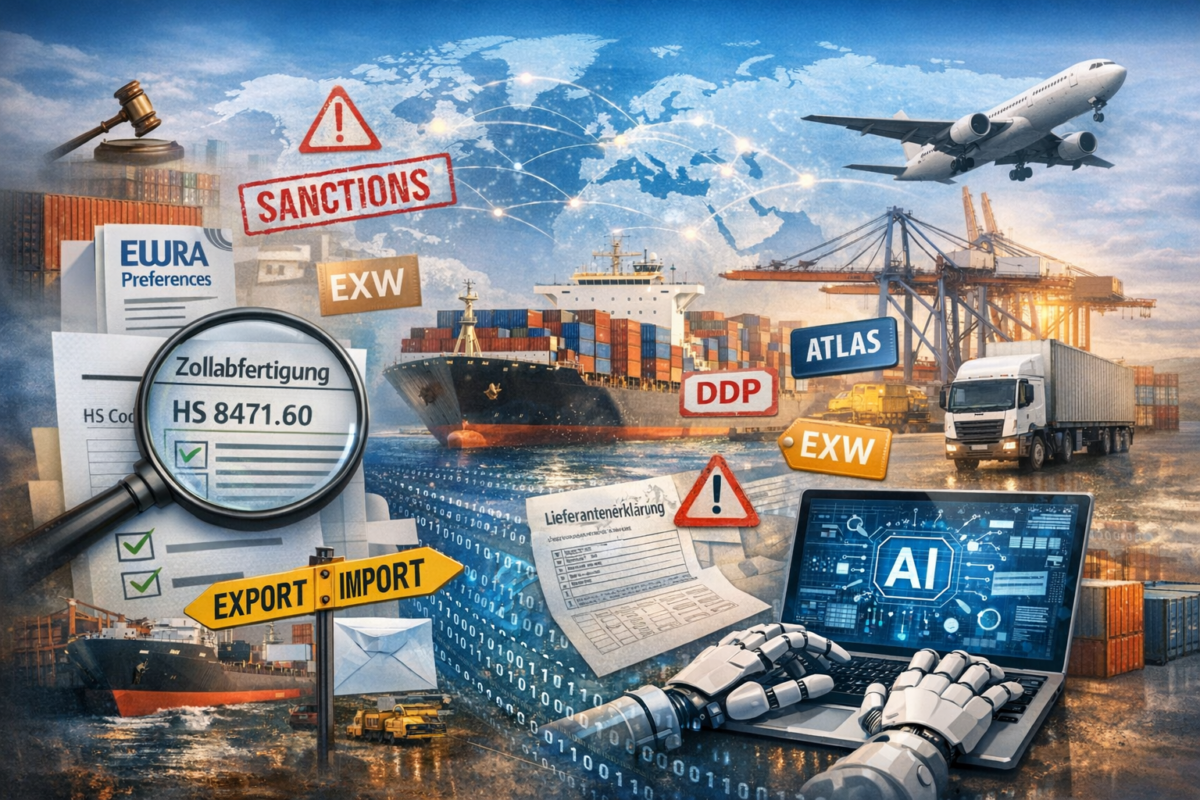
Sanctions. Preferential agreements. Supplier declarations. ATLAS. New Incoterms.
And yet customs is still often viewed as a "purely administrative issue" in purchasing.
That's risky.
Because the truth is:
The decisive customs costs do not arise in logistics—they arise in purchasing.
🔎 Where are the biggest challenges?
1️⃣ Incorrect tariff classification
Incorrect classification of goods directly affects the customs duty rate—and thus the entire calculation.
2️⃣ Preferential origin
Supplier declarations are often accepted without being checked.
But who is liable in case of doubt?
3️⃣ Incoterms without strategic evaluation
EXW ordered—but who actually bears the risk?
DDP agreed—without knowledge of the actual import requirements?
4️⃣ Sanctions & export control
Purchasing orders globally.
Compliance checks downstream.
Responsibility remains with the company.
🚢 Why does this also affect logistics?
When mistakes occur in purchasing, the operational chain feels the impact immediately:
- Delayed customs clearance
- Missing documents
- Port fees
- Blocked shipments
- Double burden for dangerous goods + customs
- High manual post-processing effort
Strategic decisions are implemented at the operational level.
And it costs time, money, and reputation.
🤖 AI in customs clearance – hype or real leverage?
Customs in particular involves enormous manual effort:
- document verification
- tariffing
- sanctions list screening
- plausibility checks
- Data transfers to various systems
This is where artificial intelligence comes in.
When used correctly, AI can:
✔ Reduce error rates
✔ Accelerate processes
✔ Minimize compliance risks
✔ Create transparency regarding customs and cost drivers
✔ Reduce the workload on operational teams
But AI cannot replace expertise—it requires competence, structure, and clear processes.
That is why it is crucial to combine customs expertise with digital competence.
🎯 Strategic advantage instead of operational stress
Modern supply chains need:
✔ Customs expertise in purchasing
✔ Understanding of Incoterms & liability
✔ Clearly defined interfaces between purchasing, logistics & customs
✔ Transparency regarding cost and risk drivers
✔ Practical training
In our seminar "AI in Customs Clearance, " we show how companies can combine regulatory requirements with technological solutions—in a practical, understandable, and directly applicable way.
The question is:
Do we use it—or do we manage it?